;)
Preparations and Checklist before Emission Testing
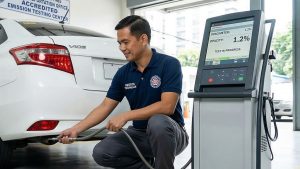
This comprehensive preparation and checklist is compiled from the Implementing Rules and Regulations (IRR) of Republic Act 8749 (Annexes B and C), industry best practices, and recent technical guidelines for both Private Emission Testing Centers (PETCs) and Private Motor Vehicle Inspection Centers (PMVICs).
Phase 1: Administrative & Documentation
- Verify Registration Documents: Check the original or clear photocopy of the Official Receipt (OR) and Certificate of Registration (CR) to ensure vehicle specifications match the actual vehicle.
- plate number,
- body color,
- vehicle classification,
- body description,
- chassis model & series,
- engine model & number,
- engine displacement,
- fuel type,
- year model.
- Identify Emission Tier: Determine from the registered year model if the vehicle is Euro 4/IV or lower emission tier Euro 2/II and below to accordingly determine the passing exhaust emission standard.
- Euro 4/IV: year models from 2016 and up. The emission testing equipment used has to have the necessary decimal precision (0.001 – 0.0001) 3 to 4 decimals to capture ultra-low readings. Otherwise, the test result will be “zero” – “0.00”.
- Euro 2/II: year models from 2008 to 2016.
- Interim Emission Standard (pre-Euro): year models from 1900’s to 2007.
Phase 2: Ocular Inspection
- System Integrity: Inspect the mechanism and emission control devises for integrity.
- Catalytic Converter
- Diesel Oxidation Catalyst and Diesel Particulate Filter
- Selective Catalytic Reduction (SCR) for Euro 5/V diesel engine technology
- Exhaust Gas Recirculation System
- Positive Crankcase Ventilation
- Evaporative Emission Control System (for fuel vapors)
- Engine Control Unit (ECU) -computer actuated engines
- Turbocharger and Intercooler
- Fuel Injector seal (no seals is a sign of tampering)
- Exhaust System Integrity: Inspect the entire exhaust line for holes, heavy rust, or leaks.
Rationale: Leaks dilute the sample with ambient air, causing false Oxygen spikes.- Entire exhaust pipe
- Muffler
- If exhaust pipes have two or more ends, leave one uncovered and use it for testing.
- Anti-modification of pipe and muffler.
- Fluid Leak Check: Ensure there are no active leaks of fuel, engine oil, or coolant. Rationale: High- RPM testing poses a fire or engine failure risk if leaks are present.
- Noise Level Assessment: Listen for abnormal engine sounds (knocking/tapping). Ensure the muffler is functional.
- Ocular Smoke Check: For gasoline vehicles, ensure no blue or black smoke is visible at idle. For diesel, check for excessive “sustained” smoke before starting the formal test.
- Air Filter Inspection: Briefly verify that the air filter is not heavily clogged, as this will cause a “rich” mixture and lead to failure.
Phase 3: Thermal & Mechanical Preparation
- Engine Temperature: Run the engine until it reaches at least 70°C (Normal OperatingTemperature). A 15-minute road run is recommended if the vehicle is cold.
- Accessory Shutdown: Turn OFF the Air Conditioning (A/C), headlights, radio, and all other electrical loads.
- Transmission & Safety: Set the gear to Neutral (N) and Park (P) and firmly engage the handbrake.
- Check Engine Light: Ensure the dashboard “Check Engine” light is not illuminated.
- Check Engine noise: Check abnormal engine noise – knocking or tapping, indication of engine wear.
| Sound Type | Potential Source | Likely Indication |
| Metallic Knocking | Combustion Chamber | Pre-ignition or Detonation: Often caused by low- quality fuel, incorrect timing, or carbon buildup. In diesel engines, this is frequently due to “ignition delay” or faulty injectors. |
| Rapid Ticking/Clicking | Valvetrain | Low Oil Level or Pressure: Insufficient lubrication of the lifters or rockers. It can also indicate valves that are out of adjustment. |
| Heavy Thudding | Lower Block | Worn Main or Rod Bearings: A deep, rhythmic thud that usually gets louder under load, indicating a serious internal failure. |
| High-Pitched Squeal | Accessory Belts | Worn Serpentine Belt or Pulley: Slipping belts or a failing alternator/water pump bearing. If it occurs only during steering, it points to the power steering pump. |
| Hissing or Sizzling | Cooling or Vacuum | Coolant Leak: Pressurized coolant escaping and hitting hot engine parts. Alternatively, a vacuum leak from a cracked hose. |
| Whistling | Turbocharger | Air Intake Leak or Turbo Wear: A shrill whistle during acceleration often indicates a leak in the intercooler piping or worn turbocharger bearings. |
| Banging/ Abnormal Vibration | Engine Mount | Rubber is loose or torn. |
- Check Transmission and Propeller Noise:
| Sound Type | Potential Source | Likely Indication |
| Whining or Humming | Fluid/Pump | Low Transmission Fluid: Starvation of the pump. In automatics, it may indicate a failing torque converter. In manuals, it often points to worn shaft bearings. |
| Grinding (Manual Transmission) | Synchronizers | Worn Synchros or Clutch: Occurs specifically during gear shifts. If it happens while the clutch is engaged in neutral, the input shaft bearing may be failing. |
| Grinding (Automatic Transmission) | Planetary Gears | Internal Component Failure: Often accompanied by metal shavings in the fluid, indicating severe wear of the gear sets. |
| Clunking/Banging | Mounts or Driveline | Broken Transmission Mounts: A “thump” when shifting from Park to Drive or during gear changes. Can also indicate worn U-joints or CV joints. |
| Buzzing or Chattering | Fluid/Valves | Fluid Contamination: Air or water in the fluid (foaming) or a failing internal solenoid valve. |
Phase 4: Fuel-Specific Protocols
For Gasoline-Fed Vehicles (Annex B of the IRR of Philippine Clean Air Act)
- Pre-Conditioning: Accelerate the engine to approximately 2,500 RPM for 10–15 seconds to clear residual gases, then return to a stable idle.
- Lambda (λ)Diagnostic: Use a 4-gas or 5-gas analyzer to verify that the Lambda is near 1.00 (±0.03).
- Stoichiometric Balance: Verify that CO2 is high (above 13%) and O2 is low (below 2%), indicating efficient combustion.
For Diesel-Fed Vehicles (Annex C of the IRR of Philippine Clean Air Act)
- Soot Scavenging: Perform 2 to 3 rapid accelerations (free acceleration) to expel loose soot and carbon deposits from the tailpipe and muffler.
- RPM Sensor Attachment: Securely attach the RPM sensor to the engine to track the “quick and violent” accelerations required for the K-value measurement.
- Exhaust Probe Clearance: Ensure the tailpipe is clear of obstructions and can accommodate the opacimeter probe for at least 30cm of depth (if applicable).
Phase 5: Electronic Diagnostic (Advanced Best Practice)
- OBD-II Scan: Plug in an electronic diagnostic tool to check for Diagnostic Trouble Codes (DTCs)
Summary for the Technician: If any item (Integrity of Components, Leaks, Noises, Color of Exhaust, or Thermal Temp) fails this checklist, the vehicle should be referred for maintenance before the formal emission test is conducted to avoid an official “Fail” result in the LTO database.
If registration documentation does not match the actual vehicle, the vehicle owner should be advised to correct the error before any emission test is conducted.