;)
The quest for clean air and roadworthiness depends on the accuracy of our testing instruments. During the 2024 DOTr Technical Working Group (TWG) deliberations on smoke testing procedures, a significant discrepancy was identified between the factory-embedded programs of several opacimeters in the Philippine market and the mandatory requirements set forth in Annex C of the Implementing Rules and Regulations (IRR) of the Clean Air Act (RA 8749).
To ensure a “no-nonsense” implementation of emission standards measured through the testing equipment, we must bridge the gap between international machine defaults and Philippine law.
The Protocol Gap: Machine Defaults vs. Philippine Law
The TWG findings revealed that many popular opacimeter brands follow international standards (such as China’s GB3847-20051 or the U.S. BAR97) that do not fully align with the specific bandwidth requirements of Annex C.
| Some Opacimeter Equipment’s Test Procedure | Annex C of CAA IRR’s Test Procedure |
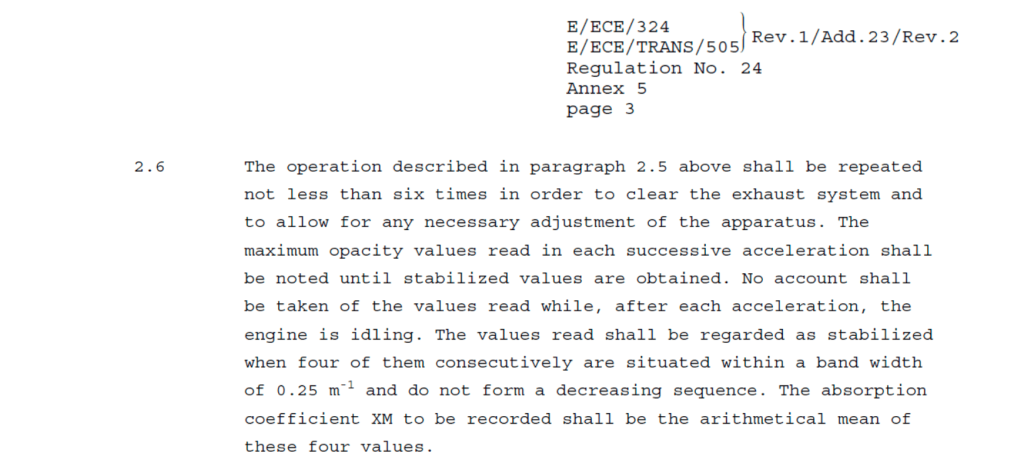
| 3x Accelerations with results with 5% deviation, to automatically get average reading. In Cartesykj MQY-200 and QROTECH’s OPA-102, 3x-6x accelerations is required to get average reading but disregards the 5% deviation. | 4x Accelerations with consecutive results of not less than 0.25 m-1 bandwidth to get average reading. |
1 GB3847-2005 “Limits and Measurement Methods for Exhaust Smoke from Compression Ignition Engine and Vehicles Equipped with Compression Ignition Engine.”
https://www.chinesestandard.net/PDF/English.aspx/GB3847-2005 and latest amendment: GB3847-2018
https://www.chinesestandard.net/PDF.aspx/GB3847-2018
While certain Opacimeter brands follow China’s test standard, in contrast, Test Procedure Standard in the Annex-C of the IRR of Philippine Clean Air Act is based on UN Regulation 24 Rev.1/Add.23/Rev.2, paragraph 2.6 of Annex 5, page 3:
Here are opacimeter brands with averaging results after three to six times (3x – 6x) accelerations, but without the bandwidth requirements:
- FOFEN Opacimeter model FTY 100
- KOENG Opacimeter model OP-201
- QROTECH Opacimeter model OPA-102/101
- CARTESYSK Opacimeter model MQY-200
The Joint Role of DENR and DOTr in Emission Equipment
DENR’s equipment certification is limited to “principles of operations” and do not touch the test procedures, which is in the realm of Department of Tranportation’s responsibilities, clearly stated in the RA 8749 Section 21-c:
“The DOTC (now DOTr), together with the DTI and the Department (DENR), shall establish the procedures for the inspection of motor vehicles and the testing of their emissions for the purpose of determining the concentration and/or rate of emission of pollutants discharged by said sources.”
Therefore, we can strongly conclude that DOTr has to inspect the test procedures of machine-imbedded program for conformity with regulations.
Recommended Regulatory Adjustments for DOTr Implementation
Technical Oversight by ISLES-MIT: Integrate the ISLES-MIT team into the formal
review process for all PETC and PMVIC applicants. Their participation should focus
on the rigorous technical audit of test procedures and the verification of equipment
manuals against Philippine standards.
- Mandatory Compliance of Factory Manuals: Require all applicants to submit factory equipment manuals that explicitly demonstrate compliance with the Annex-C protocols of the RA 8749 IRR. To facilitate the transition, the DOTr may grant Provisional Authorization contingent upon the submission of a certified, compliant factory manual within a non-extendable three-month grace period.
- Mandatory Firmware and Program Realignment: Direct all existing PETCs and PMVICs to coordinate with their respective equipment suppliers for the immediate recalibration of machine-embedded software. The objective is to ensure that the automated testing sequences—specifically the 4-cycle acceleration and bandwidth calculations—conform strictly to the IRR of the Clean Air Act.
- Advisory on Non-Compliant International Standards: Issue an official DOTr Advisory notifying the industry that emission equipment following outdated Chinese or Korean standards (which utilize simple averaging instead of the Philippine bandwidth requirement) is considered non-compliant. A defined “Compliance Window” should be established to allow centers to correct these technical discrepancies and align with Annex-C.
- Systematic Equipment Audits: Establish a regime of Continuing Technical Audits for emission equipment, to be conducted by ISLES. These inspections should occur through three channels: annually during the renewal of authorization, via pre-scheduled technical reviews, and through unannounced “spot” inspections to ensure sustained operational integrity.
Prevention of Equipment Misrepresentation (Refurbishing & Recycling)
- Physical Integrity and Anti-Tampering Protocols: DOTR-LTO Regional inspectors must be trained to execute a Physical Integrity Audit during the inspection of emission equipment. This audit must prioritize the identification of tampering signatures, including:
- Serialized Consistency: Evidence of re-stamped or altered serial numbers.
- Cosmetic Masking: Use of fresh paint to cover structural wear or previous branding.
- Historical Markers: Traces of old calibration stickers or “void” seals.
- Operational Wear: Physical scratches on the probe, handle, or chassis, and accumulated internal dust, which are inconsistent with the condition of newly commissioned equipment.
The Need for High-Precision Equipment (Euro 4/IV and Beyond)
As the Philippines transitions to Euro 4/IV and higher standards, the limitations of older 2-digit gas analyzers have become apparent. Modern, computer-controlled engines produce such low emissions that they often register as “0.00” on outdated machines.
- The Problem: Older machines cannot “see” ultra-low emission levels, leading to potential data inaccuracies.
- The Solution: PETCOA advocates for a transition to equipment capable of 3 or 4 decimal place readings. This precision is necessary to capture the actual output of vehicles equipped with advanced exhaust management devices like catalytic converters and particulate filters.
The Path Forward: IT-Integrated Monitoring
The ultimate deterrent against “non-appearance” and data manipulation is the integration of machine data with a centralized IT system. PETCOA calls for an upgraded IT framework, potentially in collaboration with the DICT, to enable the automatic capture and transmittal of:
- Engine Temperature: Ensuring the vehicle reached the 70°C threshold.
- RPM Readings: Verifying the engine was running and accelerated properly.
- 4-Gas readings: identification of Lambda and Stoichiometric Balance.
- Raw Bandwidth Data: Automatically calculating the 0.25 m⁻¹ variance across four accelerations.
By aligning our equipment protocols with the law and leveraging modern IT systems, we can ensure that every emission test conducted in the Philippines is a true reflection of roadworthiness, protecting both the environment and the public’s trust in the testing system