Made Possible by Existing Regulations and Equipment Requirements
The twin goal of motor vehicle testing is to achieve road safety and clean air. However, regulatory bodies have yet to build regulations to make this possible. Historically, the Private Emission Testing Center (PETC) program has faced challenges related to “non-appearance” and data manipulation. With the advent of the Private Motor Vehicle Inspection Program (PMVIC) that also has the same emission testing component copied from the PETC program, these challenges have yet to be addressed.
The Need for Technical Harmonization
A primary obstacle to honest testing has been the lack of alignment between regulatory agencies. While the Department of Environment and Natural Resources (DENR) originally required 5-gas analyzers, earlier Department of Transportation (DOTr) and Land Transportation Office (LTO) issuances only required the capture and transmission of two gases: Hydrocarbons (HC) and Carbon Monoxide (CO). This discrepancy allowed some centers to purchase less capable equipment, making it easier to program computers to randomly generate passing values for just two gases without conducting an actual test. To counter this, advocates are calling for DOTr-LTO regulations to be harmonized with DENR standards, ensuring all centers utilize advanced analyzers capable of verifying the biological “fingerprint” of engine combustion.
Upgrading for Euro 4/IV and Higher Standards
As the Philippines transitions to Euro 4/IV and higher emission tiers, the limitations of older emission equipment have become a technical loophole for vehicles not to comply with higher standards. Modern vehicles utilize computer-actuated combustion controls, catalytic converters, and particulate filters that drastically reduce emissions. While older equipment often records results to only one or two decimal places (e.g., 0.1 or 0.01), Euro 4/IV vehicles produce emissions so low they require sensitive equipment with three or four decimals (e.g., 0.001 or 0.0001) to capture any reading at all.
When outdated machines record a “0.0” result, it is often a literal interpretation of the machine’s inability to see the gas, rather than the absence of emissions—which is scientifically impossible for a running engine. Upgrading to high-precision equipment ensures that every test result is a true reflection of the vehicle’s performance, leaving no room for fabricated “zero” readings.
The 4-Gas Solution and Lambda Verification
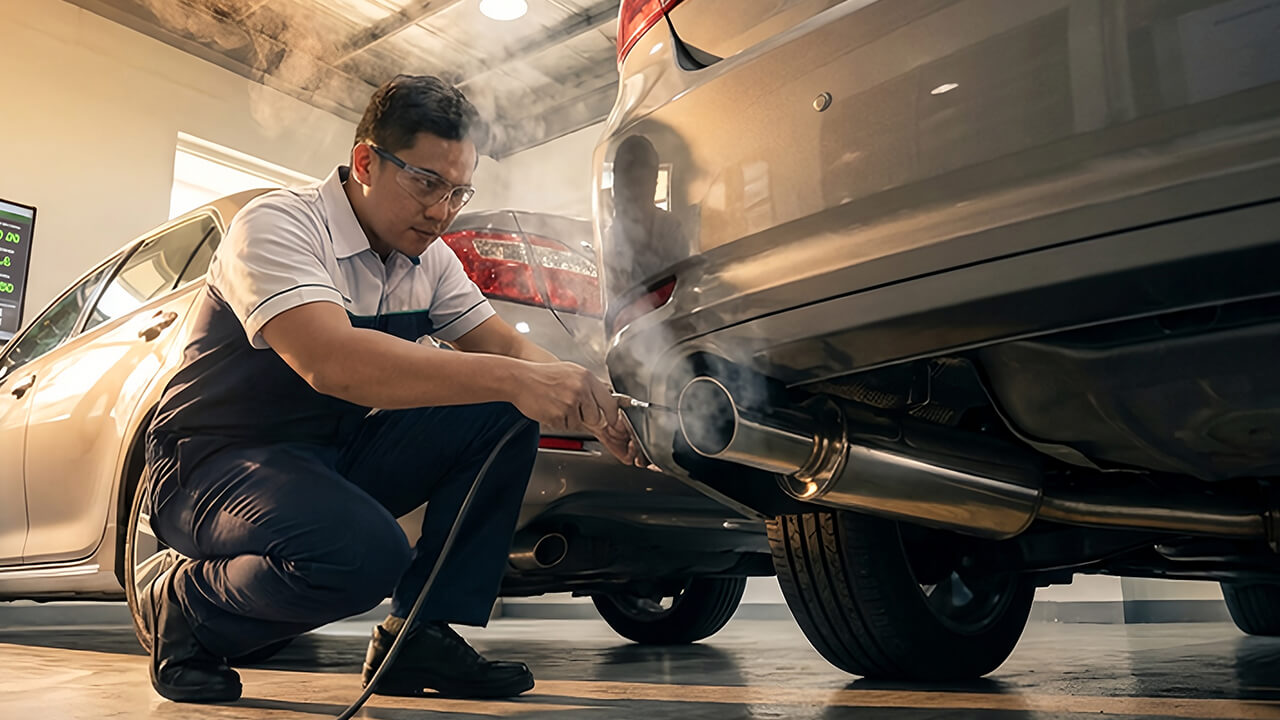
The most effective deterrent against sham testing is the mandatory capture and transmission of four gases: HC, O2, CO, and CO2, (While a 5th gas, NOx, is produced, it requires a “loaded” test on an expensive dynamometer and is not currently feasible for standard idle tests).
The interrelationship between these four gases is governed by the “Lambda” (air-fuel ratio). For example, if a transmitted test result shows low HC (indicating compliance) but high O2 levels, it reveals an inefficiency in combustion that should naturally result in high HC. Such a discrepancy is a clear indicator of data manipulation. By requiring the transmission of all four gases to the DOTr-LTO Data Repository Server, the government can use automated programs to analyze these relationships and instantly weed out fraudulent results.
Enforcing Strict Test Protocols
Beyond gas analysis, the elimination of “non-appearance” requires the strict enforcement of test protocols. For gasoline vehicles, this requires the presence of catalytic converter and reading of RPM and engine temperature. For diesel vehicles, the opacimeter test should capture and transmit more than just the final K-value. Valid tests must include: (i.) Engine Temperature: Ensuring the vehicle has reached its normal operating temperature before testing; (ii.) RPM Readings: Verifying that the engine was actually running and accelerated as required; and (iii.) Bandwidth Differences: Recording four consecutive accelerations to ensure the variance does not exceed 0.25 m-1.
If these parameters—temperature, RPM, and bandwidth—are made mandatory for transmission, it becomes nearly impossible to manipulate a test result without a vehicle being physically present at the center.
A Commitment to Improvement
Needless to mention, the current DOTr LTO DENR regulations should be geared towards equipment improvement and test-protocol incorporation in the data-capture systems of the DOTr LTO data repository server.
PETCOA remains dedicated to supporting these technical upgrades. By adopting modern test equipment with higher decimal precision, expanding to 4-gas analysis, and integrating comprehensive test-protocol data into the DOTr-LTO data repository server, the industry can provide the “no-nonsense” implementation the public deserves. Harmonizing these standards across PETCs and PMVICs will ensure that “non-appearance” becomes a thing of the past, protecting both the environment and the integrity of the transportation sector.