;)
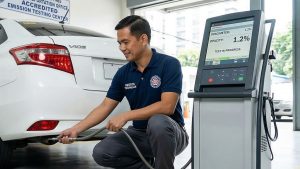
Under Annexes B and C of the Department of Environment and Natural Resources (DENR) Department Administrative Order No. 2000-81, specific emission test protocols were adopted as the legal standards for gasoline- and diesel-fed motor vehicles. Within these regulatory frameworks, the pre-test inspection stands as a critical, mandatory phase of the process that must be meticulously executed before any gas probe or opacity meter is introduced to measure tailpipe emissions.
This mandatory status exists because an automobile is an interconnected system; mechanical, electrical, and structural components must co-opt seamlessly to deliver optimal engine performance and combustion efficiency. When these secondary systems deteriorate, they place an artificial parasitic load on the engine or corrupt its management systems, causing a vehicle that might otherwise be mechanically sound to exceed its original factory emission standards.
Therefore, Authorized Motor Vehicle Emission Control Technicians (MVECTs) carry a professional responsibility to verify that these parts and components are functioning correctly during the pre-test phase, ensuring that auxiliary faults do not contribute to excessive atmospheric pollution.
Key Parts and Components Evaluated During Pre-Test Inspection
To ensure an accurate and fair evaluation, the following critical systems are inspected to identify how their mechanical or electrical inefficiencies directly compound a vehicle’s final emission discharge:
- The Clutch System (Transmission Linkage): An improperly functioning clutch system, typically characterized by a “sliding” or slipping clutch, prevents the efficient transfer of kinetic power from the engine flywheel to the transmission. To compensate for this internal energy loss and achieve the necessary driving torque, the engine is forced to run at a significantly higher RPM than normal, driving up fuel consumption and accelerating emission discharges.
- The Braking System (Mechanical Drag): Malfunctions within the braking system—commonly referred to as “brake drag”—occur when a brake cylinder fails to retract or a brake rotor remains partially clamped while the vehicle is in motion. This continuous drag imposes an artificial, heavy load on the vehicle. To counter this parasitic resistance, the engine must deliver an “extra push,” burning more fuel and directly increasing exhaust emissions.
- Tires and Wheels (Rolling Resistance): Underinflated tires significantly increase a vehicle’s rolling resistance because an excessive amount of the tire’s surface area flattens against the pavement, drastically increasing road friction. The engine must generate continuous additional power simply to overcome this tire drag, resulting in an avoidable spike in emission output.
- Fuel Tank, Lines, Hoses, and Filler Cap (Evaporative Emissions): Structural leaks in the fuel tank, cracked delivery lines, or a loose, degraded fuel filler cap allow raw fuel vapors to escape directly into the atmosphere. While these volatile organic compounds (VOCs) do not exit through the engine’s tailpipe, they represent dangerous “evaporative emissions” that carry a severe impact on public health and localized air quality.
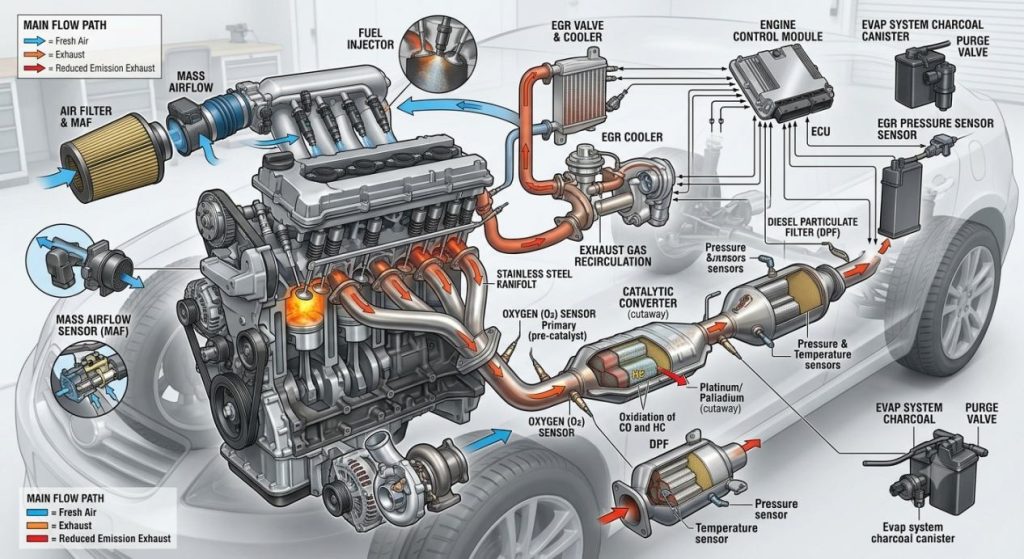
- The Exhaust System (Sensor Integrity): Physical structural breaches, cracks, or loose gaskets between the engine manifold and the tailpipe cause harmful exhaust leaks. An exhaust leak introduces ambient air into the exhaust stream, which completely throws off the oxygen sensors. This false data tricks the Engine Control Unit (ECU) into miscalculating the fuel trim, causing the engine to alternate between severe fuel-rich (“high emission discharge”) and fuel-lean (“low power/misfire”) states. Furthermore, these leaks allow raw, toxic gases to bypass downstream emission control devices entirely.
- Emission Control Devices (Catalytic Converters & Diesel Particulate Diffusers/Filters): The catalytic converter (for gasoline) and the Diesel Particulate Diffuser (DPD/DPF for diesel) serve as the primary defensive line, chemically neutralizing or physically trapping noxious soot and toxic gases before they can leave the tailpipe. A damaged, clogged, or chemically fouled emission control device cannot execute this catalytic process, triggering an immediate, massive increase in raw pollution discharge.
- Engine Management Sensors (Oxygen and Mass Air Flow Sensors): The Mass Air Flow (MAF) sensor and the Oxygen (O2) sensor serve as the electrical eyes of the engine management system. If these sensors are damaged, dirty, or sluggish, the ECU receives corrupted data regarding air-fuel ratios. This typically forces the engine into a continuous “rich” operating mode, characterized by incomplete combustion and a severe spike in Hydrocarbons (HC) and Carbon Monoxide (CO).
- Ignition and Fuel Injection Systems (Spark Plugs & Injectors): Uncalibrated, leaking fuel injectors or worn, defective spark plugs disrupt the uniform delivery and ignition of the fuel charge. This directly results in unburnt fuel or poor flame propagation—known as incomplete combustion—which pumps highly concentrated noxious gases and unburnt particulates straight out into the open air.
- Unwarranted Structural Modifications (Excess Vehicle Weight): The installation of heavy, aftermarket structural modifications or carrying unnecessary permanent cargo significantly increases the total curb weight of the vehicle. Added weight demands sustained, higher power output from the engine across all driving phases. This increased engine workload naturally correlates to higher overall fuel consumption and elevated emission discharges.
Conclusion: The True Purpose of Emission Testing
The technical realities evaluated during a pre-test inspection prove that emission testing is not merely a bureaucratic “pass/fail” checkmark for vehicle registration renewal. Rather, it serves as a highly precise diagnostic window into the holistic operational health of a motor vehicle.
When a vehicle fails an emission test, the tailpipe data is often a symptom of an underlying mechanical, electrical, or structural inefficiency elsewhere in the vehicle’s ecosystem. Shifting the focus toward mandatory pre-test inspections guarantees that vehicle owners understand the deep correlation between proper periodic maintenance and true environmental compliance.
For the Private Emission Testing Center Owners Association (PETCOA), advocating for rigorous pre-test protocols and the unmanipulated digital transmission of raw machine data ensures that our testing centers protect not only the integrity of the registration system but also the literal quality of the air breathed by our countrymen.