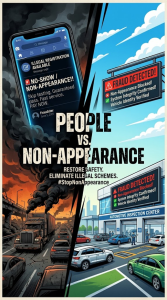
The motor vehicle inspection and testing industry is currently facing a critical threat: the systemic practice of “Non-Appearance” (N.A.) where a motor vehicle is registered without undergoing proper physical testing. This scheme exploits perceived weaknesses in the registration process, capitalizing on a dangerous trade-off where public safety and environmental health are sacrificed for personal convenience.
Why does N.A. persist? The answer lies in an insatiable demand for expediency. Many vehicle owners and operators prioritize the ease of avoiding a testing center over their legal and moral obligation to ensure their vehicles are in roadworthy condition. This is because the current level of understanding about emission compliance, and the existing system makes it easy for N.A. scheme to become available.
Fueling this cycle are ubiquitous LTO fixers who systematically solicit non-appearance options, directly catering to motorists seeking immediate convenience. This open solicitation bridges the gap between a registrant’s preference for shortcuts and an active underground network.
When a registrant chooses N.A., they aren’t just “skipping a line”—they are bypassing the primary safeguard against excessive smoke emissions and mechanical failures. This lack of public education on Responsible Vehicle Ownership has allowed a profitable illegal market to thrive at the expense of our countrymen’s health and safety.
The Evolution of Manipulation
What began as rudimentary manual manipulation has evolved into a sophisticated, system-based exploitation. While government efforts have frequently focused on catching individual “mice” in the kitchen, they have yet to dismantle the “breeding ground” – the IT infrastructure and regulatory loopholes that allow data to be fabricated or bypassed entirely.
Our Roadmap to a Transparent System
Stopping “Non-Appearance” requires more than just stricter policing; it requires a technological overhaul of the testing process with strict legal accountability. PETCOA advocates for the following pillars of reform:
- Mandatory Equipment-Read Results: We must move beyond simple “Pass/Fail” binary results. The LTO system should require the direct transmission of raw data from the machines, including:
- 4-Gas Analysis: Capturing CO, HC, CO2, and O2 levels to ensure combustion integrity.
- The “Biological Heartbeat”: Mandatory recording of Engine Temperature and RPM to prove that a physical, running vehicle was actually present during the test.
- Lambda Ratio: Scientific verification of the air-fuel mixture to prevent “ghost” data entry.
- Periodic Maintenance as a Prerequisite: Proof of mandatory periodic maintenance should be integrated into the registration process. This shifts the focus from “passing a test” to “maintaining a standard.”
- DICT System Intervention & Audits: We call for the involvement of the Department of Information and Communications Technology (DICT) to audit government and privately-run IT systems. Independent oversight will help identify the “digital glitches” and backdoors that currently make data manipulation possible. A secured system will make N.A. manipulations impossible and stop the demands offered by the convenience of N.A.
- Continuing Public Education: It must become second nature for operators to view vehicle maintenance as a social responsibility. A well-maintained vehicle is not just a personal asset; it is a contribution to public safety and clean air.
- Governance and Administrative Integrity: The Nemine Contradicente Rule:
Beyond technology, we must address the human element of the authorization process. To prevent “fixing” and ensure that only compliant facilities are authorized to operate, we propose the adoption of the Nemine Contradicente (unanimous decision) rule for all Technical Working Group (TWG) evaluations that should involve industry experts and regulators.
Under this principle, an authorization or inspection should only proceed if the technical evaluation is unanimous. By requiring that no member of the TWG contradicts the finding of compliance, we eliminate the possibility of a “single point of failure” where an individual official could be influenced. Once a unanimous technical endorsement is reached, the final approval by the Authorization Committee should become a ministerial (pro-forma) act, ensuring that the process is driven by technical merit rather than administrative discretion.
The Path Forward
The technology to stop “Non-Appearance” exists today. What is required is the political will to implement these standards and a collective commitment from the public to reject the shortcut of N.A. in favor of a cleaner, safer Philippines.